Monday, October 16, 2006
I blew the dust off this little treasure last night and at last the kids decided it was time to share it with the world. This was done in 2002. Britain is now as tall as Traci and Sara's catching up fast. It's incredible what can happen in four years. It's things like this that make a parent ask, "Where has the time gone?"


Saturday, October 14, 2006
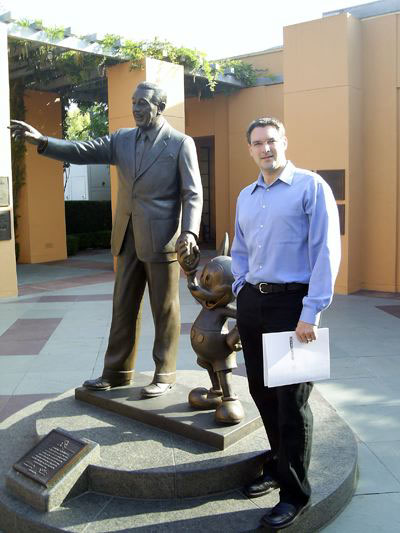
Whenever we set out to do a thing, most people ask the question of themselves or someone else, "How ought this to be done?" On one hand it's a lazy natured way to avoid reinventing the wheel and on the other hand it's a sense that there's a safety in walking a defined path rather than blaze a new trail. Furthermore, those who have gone before can be both acknowledged if it goes right and blamed if it goes wrong. The forerunner is, in some ways, deemed responsible for all who come after him. In reality, forerunners are the most revered and misunderstood members of society. Walt Disney was one such person. I don't know much about Walt but I feel as though I do. Today I'm flying to Burbank to pitch a software program to some folks at Disney Studios. This is the fulfillment of a lifelong dream for me. Not only have I always wanted to go to the studios, I've always loved the ideal of Disney. The man lived by the motto, If You Can Dream It, You Can Do It. Today, millions of people have smiled at the realization of his dreams and will for generations to come. Now, it's a business, devoid of new magic, for the magic lies not in the technology, but in the ability to create what you dream. It's amazing to me that after all these years, Disney still contains that charm and character worthy of the dreamer for which it's named. But look closely and you'll discover that the elements that exude that charm are those elements that have in them a piece of the dreamer. You can tell them apart from the elaborate marketing pieces that, though they bear the Disney logo, are as shallow as the money they're designed to generate. Disney was about the details, and it's in those details that the 'Disney thing' still exists. What is the Disney thing? As Dizzy said about Jazz, "If you got it you don't need an explanation, and if you ain't got it, no explanation will do." Better yet, go ask a child.
Tuesday, October 03, 2006
I've got so many thoughts swirling around today that I wish I could just put on a helmet that would keep them out, then deal with them one at a time, and find some peace. If you've noticed lately, (as many have, and thanks by the way) I've been blogging sermons. For those of you who get some sermon ideas from this site, have at it. I would tell a story were there any to tell. The problem with that statement is that there are always stories. They're everywhere, all around you, happening all the time. To be able to see them is the beautiful thing. If you haven't seen one lately, it's not because it's not there, but because you haven't been looking. Ok, I haven't been looking.
How do you see a story? Every story has a beginning, a body, and a conclusion. We get locked in with the beginning, journey through the body, and it's all to arrive at a conclusion which we can't wait for. The catch 22 is that the better the story is, the more we desire the end that we hate to see arrive. It is because of the end that we read on, for the end subconsciously claims to bring resolution to the situational conflict that locked us into the story in the first place. There's a promise that everything that's wrong with this story will be put right before the last page. Will Shakespeare identified the antithesis of the comedy with what came to be known as a tragedy. He would prepare his audience before hand (I would not have, but that's just me) by billing his plays as comedy or tragedy. In doing this he built a safeguard into the expectations of the audience that prepared them in advance for the state of the conclusion. Oh yes, things will come to and end, but hardly a pleasant one. Maybe that's what makes life so exciting. We are promised a conclusion to mortality yet, unlike Shakespeare's audience, we have not been told whether this is a comedy or a tragedy. Because of this, most people tend to gravitate toward one assumption or the other and this I've learned. That the two audiences offend one another by their approach based upon their assumption of the conclusion. Every tragedy includes comic elements and every comedy includes some air of tragedy. The tragic audience can't see the joy of the comedy and the comic audience sees the humor in tragedy. Each is highly offensive to the other.
To bring this rambling thought to a close, some days I wake up seeing life as a tragedy and praying for a comic end and some days I wake up seeing life as a comedy and praying that no tragedy casts a shadow this sunny state of things. Each has it's own anxiety and there's really only one cure for both audiences. Peace. Philippians 4 says "Don't worry about anything, pray about everything, tell God what you need, and be thankful for whatever He gives." I paraphrase, but that's the radical idea there. Now it goes on to say that if you do this, "the Peace of God, which passes all understanding, will guard your heart and mind in Christ Jesus." Oh look, I just found a helmet.
Now the beauty of this is that, in Christ, the end of the story does not occur with the conclusion of life, but in fact continues on into the realm of the eternal state of communion with God. THIS is why Christians seem to live with a sense of joy even in the midst of life in this fallen world. Which, incidently, often looks an awful lot like a Shakespearian tragedy. It's not a flippant attitude toward the situational conflict that ignores the present circumstances, but a proclaimed realization that this tragedy will ultimately conclude with a reason to rejoice. Since the conclusion and not the elements determine the whole of the play, I guess Paul wasn't joking when he said to the Philippians, "Rejoice in the Lord always, and again I say rejoice." For a man whose earthly demise was a tragedy, that's an amazing statement. That's a man worth imitating. (1 Corinthians 11:1)
How do you see a story? Every story has a beginning, a body, and a conclusion. We get locked in with the beginning, journey through the body, and it's all to arrive at a conclusion which we can't wait for. The catch 22 is that the better the story is, the more we desire the end that we hate to see arrive. It is because of the end that we read on, for the end subconsciously claims to bring resolution to the situational conflict that locked us into the story in the first place. There's a promise that everything that's wrong with this story will be put right before the last page. Will Shakespeare identified the antithesis of the comedy with what came to be known as a tragedy. He would prepare his audience before hand (I would not have, but that's just me) by billing his plays as comedy or tragedy. In doing this he built a safeguard into the expectations of the audience that prepared them in advance for the state of the conclusion. Oh yes, things will come to and end, but hardly a pleasant one. Maybe that's what makes life so exciting. We are promised a conclusion to mortality yet, unlike Shakespeare's audience, we have not been told whether this is a comedy or a tragedy. Because of this, most people tend to gravitate toward one assumption or the other and this I've learned. That the two audiences offend one another by their approach based upon their assumption of the conclusion. Every tragedy includes comic elements and every comedy includes some air of tragedy. The tragic audience can't see the joy of the comedy and the comic audience sees the humor in tragedy. Each is highly offensive to the other.
To bring this rambling thought to a close, some days I wake up seeing life as a tragedy and praying for a comic end and some days I wake up seeing life as a comedy and praying that no tragedy casts a shadow this sunny state of things. Each has it's own anxiety and there's really only one cure for both audiences. Peace. Philippians 4 says "Don't worry about anything, pray about everything, tell God what you need, and be thankful for whatever He gives." I paraphrase, but that's the radical idea there. Now it goes on to say that if you do this, "the Peace of God, which passes all understanding, will guard your heart and mind in Christ Jesus." Oh look, I just found a helmet.
Now the beauty of this is that, in Christ, the end of the story does not occur with the conclusion of life, but in fact continues on into the realm of the eternal state of communion with God. THIS is why Christians seem to live with a sense of joy even in the midst of life in this fallen world. Which, incidently, often looks an awful lot like a Shakespearian tragedy. It's not a flippant attitude toward the situational conflict that ignores the present circumstances, but a proclaimed realization that this tragedy will ultimately conclude with a reason to rejoice. Since the conclusion and not the elements determine the whole of the play, I guess Paul wasn't joking when he said to the Philippians, "Rejoice in the Lord always, and again I say rejoice." For a man whose earthly demise was a tragedy, that's an amazing statement. That's a man worth imitating. (1 Corinthians 11:1)
Friday, September 29, 2006
The following was written in response to a reader who asked about my take on end time events:
I believe in progressive revelation based upon John 16:12-13. This provides evidence that revelation would occur through the work of the Holy Spirit who would “show you things to come”. This leaves us with the ability to gain insight and leaves the listener to discern between what is an educated guess and what is the prophetic word to the church. Since God does nothing without revealing it to his prophets (Amos 3:7) there will be some measure of forewarning. Whether or not the church pays attention or not may depend on the condition of their stock portfolio or whether or not it’s in the middle of football season. We’re just that fickle.
Having said that let me tell you where I’m at. I went through a period of intense interest in end time events and at the close of that dramatic season I asked myself, why? What purpose did it serve to know when the return of Jesus would occur? Consider the story of Enoch, who walked with God so closely that he was simply translated into His presence. Consider Elijah, who had much the same experience. I realized that no place in the Scripture did Jesus tell us to figure out the time, but in fact we’re told to be watchful, sober, vigilant (1 Pet 5:8), and work while it’s light (Jn 9:41). The work is to do the works of the Father (Jn 5:36), destroy the works of the enemy (1 Jn 3:8), and proclaim the good news of the Kingdom (Luke 9:2). That Kingdom is the demonstration of the power of God that began with Christ and continues today (Mark 9:1). Eschatology is secondary because whether you’re a premillennialist, postmillennialist, amillennialist, Pre-Wrath, or Partial Rapture adherent, it doesn’t change the call and commission of Christ to His church.
Consider a house full of children in which the father leaves and on his way out, leaves some instructions saying, “These things must be done before I return.” Rather than being consumed with when he will return, it would behoove me to a greater extent to do be consumed with what must be done. Even if I found out when he’s coming back, what would it change? In fact it may have a negative affect on my attitude toward his instructions. I may wait until the last minute to get His work done in order to make room for my desires.
All of eschatology can be summed up (not simplified but summed up) in a single verse, Matt 24:14. In the Latin Vulgate, “et praedicabitur hoc evangelium regni in universo orbe in testimonium omnibus gentibus et tunc veniet consummatio.” And this gospel of the kingdom shall be preached in all the world for a witness unto all nations and then shall the end come. Consider the weight of those words. What if by completing the commission we determine the end? Both our faith and faithfulness to His mandate would then produce the power that moves the hands of prophetic history forward. Faith is the one thing that affected Jesus world and caught His attention. The preaching will not happen without His body. If we do not do the work, this verse will not be fulfilled and thus the end will not come. I believe this is why prophecy is so open ended. If we do as we’re destined to do, the rise of hatred for the follower of Christ will abound and compound into the cataclysmic spiritual showdown that is foretold (Matt 24:9). We will be hated by men, yet we wish to be accepted by men. We will be mistreated, yet we wish for blessing. We will be unjustly judged, yet we claim entitlement to earthly rights. Nobody is anxious to make the kind of impact that will stir the kingdom of darkness to the boiling point against the church. But it is to be, and the generation that could usher in such a move of God could be this one. However, if Jesus were to come back today, we would have to mark out Matthew 24:14 for today, more people will die without having heard the Gospel than at any time in history. Today’s record will be broken tomorrow. We may say we’re tired of waiting on Him. Consider that He may be waiting on us. We wait for a move of God when God waits for a move of His people. In Him we live and move and have our being and as the Body of Christ, when we move, He moves. When Jesus said in Luke 9:1 and Matt 10:1 “Behold, I give you power and authority over all the works of the enemy, I believe Jesus meant for us to walk in that, even if the enemy doesn’t like it. The hatred that will be poured out during the tribulation won’t be toward a lazy church but to a church that is making a global impact for God. An impact that’s not an ear tickling, sin tolerant, selfish desire fulfilling impact, but rather an impact of the power of God that so infuriates the enemy that all who are called believers in Jesus Christ will be targeted for destruction by demonically driven zealots who would rather die killing us than to see us live to proclaim the good news another day. While we cry for the rapture, I believe God loves this world too much to take the hope away from it but would rather allow us yet another opportunity to see people saved. When our heart burns with a passion for the lost, then and only then will we have the courage to truly give our all to fulfill the great commission, and in that day, we would rather miss the rapture to reach one more person than be rescued from this fallen world.
I believe in progressive revelation based upon John 16:12-13. This provides evidence that revelation would occur through the work of the Holy Spirit who would “show you things to come”. This leaves us with the ability to gain insight and leaves the listener to discern between what is an educated guess and what is the prophetic word to the church. Since God does nothing without revealing it to his prophets (Amos 3:7) there will be some measure of forewarning. Whether or not the church pays attention or not may depend on the condition of their stock portfolio or whether or not it’s in the middle of football season. We’re just that fickle.
Having said that let me tell you where I’m at. I went through a period of intense interest in end time events and at the close of that dramatic season I asked myself, why? What purpose did it serve to know when the return of Jesus would occur? Consider the story of Enoch, who walked with God so closely that he was simply translated into His presence. Consider Elijah, who had much the same experience. I realized that no place in the Scripture did Jesus tell us to figure out the time, but in fact we’re told to be watchful, sober, vigilant (1 Pet 5:8), and work while it’s light (Jn 9:41). The work is to do the works of the Father (Jn 5:36), destroy the works of the enemy (1 Jn 3:8), and proclaim the good news of the Kingdom (Luke 9:2). That Kingdom is the demonstration of the power of God that began with Christ and continues today (Mark 9:1). Eschatology is secondary because whether you’re a premillennialist, postmillennialist, amillennialist, Pre-Wrath, or Partial Rapture adherent, it doesn’t change the call and commission of Christ to His church.
Consider a house full of children in which the father leaves and on his way out, leaves some instructions saying, “These things must be done before I return.” Rather than being consumed with when he will return, it would behoove me to a greater extent to do be consumed with what must be done. Even if I found out when he’s coming back, what would it change? In fact it may have a negative affect on my attitude toward his instructions. I may wait until the last minute to get His work done in order to make room for my desires.
All of eschatology can be summed up (not simplified but summed up) in a single verse, Matt 24:14. In the Latin Vulgate, “et praedicabitur hoc evangelium regni in universo orbe in testimonium omnibus gentibus et tunc veniet consummatio.” And this gospel of the kingdom shall be preached in all the world for a witness unto all nations and then shall the end come. Consider the weight of those words. What if by completing the commission we determine the end? Both our faith and faithfulness to His mandate would then produce the power that moves the hands of prophetic history forward. Faith is the one thing that affected Jesus world and caught His attention. The preaching will not happen without His body. If we do not do the work, this verse will not be fulfilled and thus the end will not come. I believe this is why prophecy is so open ended. If we do as we’re destined to do, the rise of hatred for the follower of Christ will abound and compound into the cataclysmic spiritual showdown that is foretold (Matt 24:9). We will be hated by men, yet we wish to be accepted by men. We will be mistreated, yet we wish for blessing. We will be unjustly judged, yet we claim entitlement to earthly rights. Nobody is anxious to make the kind of impact that will stir the kingdom of darkness to the boiling point against the church. But it is to be, and the generation that could usher in such a move of God could be this one. However, if Jesus were to come back today, we would have to mark out Matthew 24:14 for today, more people will die without having heard the Gospel than at any time in history. Today’s record will be broken tomorrow. We may say we’re tired of waiting on Him. Consider that He may be waiting on us. We wait for a move of God when God waits for a move of His people. In Him we live and move and have our being and as the Body of Christ, when we move, He moves. When Jesus said in Luke 9:1 and Matt 10:1 “Behold, I give you power and authority over all the works of the enemy, I believe Jesus meant for us to walk in that, even if the enemy doesn’t like it. The hatred that will be poured out during the tribulation won’t be toward a lazy church but to a church that is making a global impact for God. An impact that’s not an ear tickling, sin tolerant, selfish desire fulfilling impact, but rather an impact of the power of God that so infuriates the enemy that all who are called believers in Jesus Christ will be targeted for destruction by demonically driven zealots who would rather die killing us than to see us live to proclaim the good news another day. While we cry for the rapture, I believe God loves this world too much to take the hope away from it but would rather allow us yet another opportunity to see people saved. When our heart burns with a passion for the lost, then and only then will we have the courage to truly give our all to fulfill the great commission, and in that day, we would rather miss the rapture to reach one more person than be rescued from this fallen world.
Tuesday, September 26, 2006
The Future Belongs to the Storyteller.
The hum of the sliding doors and the cool air said 'welcome' as I wandered into the most incredible grocery store in Austin, Whole Foods Market downtown. It's a few minutes from work so I enjoy going there for lunch. A stroll past the deli, pasta bar, seafood counter, and back to the chocolate fountain is a feast for the senses. It's a place for hippies with money and while I'm not a hippie nor do I have money, I still feel welcome. I had a sandwich made and on the way to pay stopped by the brighly lit section filled with bottled drinks with names like Odwalla, Naked, Vitamin Water, Bolthouse Farms, and Pom Wonderful. I picked one up trying to figure out why in the world anyone would pay so much for so little. On the back of the bottle I picked up, was a story of the family that runs the company that makes the super healthy concoction. I was hooked and read the whole thing. I didn't buy it but I stood there like a fool and read the back of a bottle. The next bottle I picked up didn't have a story about family values, but rather a funny schtick about why in the world you would want to drink this stuff. It poked at the FDA and even itself but, again, I was grinning. It seems like someone's breaking the rules when a product for purchase foregoes dry facts to put a bit of fun in its packaging. It got me to thinking about facts and fiction. God bless the internet but it's made facts free. Facts are everywhere and as long as you have that computer, any question can be answered and any statement of fact can be found. Formerly priceless information is now free. It's truly a wonderful world we live in. But with all those facts, do you think people are interested? For awhile maybe and then we all begin to sound like Cliff from Cheers. We know a little about everything and a lot about nothing. This opens up the world to the storyteller. It is the right brained person who will eventually rule the world, for as the market for facts is saturated, the appetite for creativity is growing. Growing to the point that those who have the ability to tell a story may find that the world opens up to them in new ways. On this note, Jesus would do well here today. "A certain man had two sons" or "A sower went forth to sow" or "Who of you having a servant" or "There once was a rich man" or even "The Kingdom of Heaven is likened unto..." Ahh the master storyteller. Stories give us a clearer perspective for they walk us through events that we would have never encountered and introduce us to characters we would have never known. Though the stories themselves may not be true, stories often convey 'truth' to the heart whereas facts only affect the mind. The most powerful stories, however, are those that are both true and convey truth at the same time. The message of the Gospel is that kind of story. I was told recently that many of the 7000 islands of the south pacific have people on them who have never heard the Gospel. "Never heard the Gospel???" I said. How in the world is that possible today? He said, "The last time some of them had a missionary was 30 years ago and since that time there have been children born so in some places in the world there are 30 year old people who have never heard the name of Jesus. It's like being back at the turn of the century all over again. RC Sproul said that more people will die today having never heard the Gospel than at any time in history and tomorrow will set a new record. The church is at its most prosperous yet we have not kept up with the growth. I've just told you a story. It's both true and it conveys truth. I just figure that if a story can get us Americans to spend 3.50 on a bottle of juice, perhaps it will also prompt us to do more to spread the Gospel too.
The hum of the sliding doors and the cool air said 'welcome' as I wandered into the most incredible grocery store in Austin, Whole Foods Market downtown. It's a few minutes from work so I enjoy going there for lunch. A stroll past the deli, pasta bar, seafood counter, and back to the chocolate fountain is a feast for the senses. It's a place for hippies with money and while I'm not a hippie nor do I have money, I still feel welcome. I had a sandwich made and on the way to pay stopped by the brighly lit section filled with bottled drinks with names like Odwalla, Naked, Vitamin Water, Bolthouse Farms, and Pom Wonderful. I picked one up trying to figure out why in the world anyone would pay so much for so little. On the back of the bottle I picked up, was a story of the family that runs the company that makes the super healthy concoction. I was hooked and read the whole thing. I didn't buy it but I stood there like a fool and read the back of a bottle. The next bottle I picked up didn't have a story about family values, but rather a funny schtick about why in the world you would want to drink this stuff. It poked at the FDA and even itself but, again, I was grinning. It seems like someone's breaking the rules when a product for purchase foregoes dry facts to put a bit of fun in its packaging. It got me to thinking about facts and fiction. God bless the internet but it's made facts free. Facts are everywhere and as long as you have that computer, any question can be answered and any statement of fact can be found. Formerly priceless information is now free. It's truly a wonderful world we live in. But with all those facts, do you think people are interested? For awhile maybe and then we all begin to sound like Cliff from Cheers. We know a little about everything and a lot about nothing. This opens up the world to the storyteller. It is the right brained person who will eventually rule the world, for as the market for facts is saturated, the appetite for creativity is growing. Growing to the point that those who have the ability to tell a story may find that the world opens up to them in new ways. On this note, Jesus would do well here today. "A certain man had two sons" or "A sower went forth to sow" or "Who of you having a servant" or "There once was a rich man" or even "The Kingdom of Heaven is likened unto..." Ahh the master storyteller. Stories give us a clearer perspective for they walk us through events that we would have never encountered and introduce us to characters we would have never known. Though the stories themselves may not be true, stories often convey 'truth' to the heart whereas facts only affect the mind. The most powerful stories, however, are those that are both true and convey truth at the same time. The message of the Gospel is that kind of story. I was told recently that many of the 7000 islands of the south pacific have people on them who have never heard the Gospel. "Never heard the Gospel???" I said. How in the world is that possible today? He said, "The last time some of them had a missionary was 30 years ago and since that time there have been children born so in some places in the world there are 30 year old people who have never heard the name of Jesus. It's like being back at the turn of the century all over again. RC Sproul said that more people will die today having never heard the Gospel than at any time in history and tomorrow will set a new record. The church is at its most prosperous yet we have not kept up with the growth. I've just told you a story. It's both true and it conveys truth. I just figure that if a story can get us Americans to spend 3.50 on a bottle of juice, perhaps it will also prompt us to do more to spread the Gospel too.
Monday, September 25, 2006
This video is of my good friend, Paul, leading one of my favorite songs at Golden Triangle Church on the Rock this past Sunday. Paul lost his voice the night before this yet still managed to raise the roof in two services on Sunday morning. I'm just encouraged to see him doing what he's called to do. There's no better experience in this world or the world to come than to know that you're doing what God has gifted you to do and to know that He's pleased with your exercise of that gift. God and man often seem stuck in this stalemate in which one is waiting for the other to move. In the Old Testament God's people followed the cloud and fire. In the New Testament the signs and wonders follow you. In Him we live and move, says the Scripture. Since His Spirit resides within believers, when we move, He moves. He both calls and chooses yet we still need to respond to that call. A calling is an invitation to come and be prepared for service whereas a choosing is the process of selection once the process of preparation has had its season. Many are called, but for lack of submission to the process of preparation, few are chosen to move on to that lifestyle of service. Do you have a call on your life? My prayer today is that every believer who reads this post will find themselves filled with hope and that the calling of the Holy Spirit would find pure soil in you to take root in and that fruit would be manifest in your countenance, attitude, and action. I finally pray that in all of your 'doing' that you would do the will of God and in all of your seeking that you would seek first the Kingdom of God. Amen.
Sunday, September 17, 2006
The Parable of the Cook Part 2
One thing that the cook could never seem to understand is why, after so many meals and so many restaurants built, that the patrons seem obese, the cooks seem discouraged, and the owner is not pleased. The owner, in His Manual, has promised that those who hunger would be filled, blessed, protected, led, and strengthened. The patrons long for that, but they find themselves separated from the very thing they cry for. Why? Is it the sovereign will fo the owner for some to be blessed and others to struggle? Is there any place for miracles in this age?
The owner set physical boundaries in place and then treats them like suggestions. He creates gravity and then walks on water. When a storm interrupts His nap, He commands it to stop and it does. The laws of nature bend and not just for Him. There are those who cry out, press in, simply believe, and it stops His world as He acknowledges their faith and miracles happen. In Luke 17:5 the disciples, awed by what they saw Jesus do and realizing that there was this one thing that impressed Him, saw the key and they make a request. "INCREASE OUR FAITH." Jesus let’s them know that it’s not the size but the quality. If you have faith the size of a seed you can alter the laws of nature. A seed that never takes root, or has to compete with weeds won’t do much good, but as long as the soil of your heart is fertile, amazing things will happen. Then Jesus tells an unusual story that addresses the patrons even today. He says, “Will any one of you who has a servant plowing or keeping sheep say to him when he has come in from the field, ‘Come at once and recline at the table’? Will he not rather say to him, ‘Prepare supper for me, and dress properly, and serve me while I eat and drink, and afterward you will eat and drink’?
In modern times, we are accustomed to coming to church to receive from God. We think the restaurant is for us. We come for what we get instead of coming to minister to Him first. In the Old Testament one would have never thought to go to the temple without the intention of offering a sacrifice. I may be drawn to gathering with others for what it does for me. I ought better to be drawn to gather to worship for what it does for Him. There’s nothing wrong with coming to a place for ministry but as a way of life it builds in you an expectation to be served and builds in leadership and expectation to make people happy and neither are Kingdom values.
To increase faith, bring an offering of sacrifice to Him first of all. God’s not interested in dead animals but the yieldedness of the heart. Isaiah 60:18 is the context for a key in Isaiah 62:8-10. The sacrifice of praise and worship creates a highway that draws others into the very presence of God. The instrument of your body as a living sacrifice reflects the yieldedness of the heart. To come to a worship service and do nothing is a tragedy. Lift your head, lift your voice, lift your hands, do the pious sway. “But the enemy is hindering my worship,” many people say. The man of the Gadarenes had a legion of demons who couldn’t keep him from worshipping Jesus. We worship both to BE set free and because we ARE set free. This is why you can’t tell the level of spirituality by someone’s expression of worship. You CAN however tell a lot about a persons yieldedness in their expression of sacrifice for in true worship there must be an offering.
Servants, you’ve worked hard in the fields. Now let’s set a meal for Him. And if we eat, great, but if all we do is to prepare a meal for Him, it’s reason enough to gather. The promise, though, is true. Prepare and serve Him first, and afterward, you will be filled.
One thing that the cook could never seem to understand is why, after so many meals and so many restaurants built, that the patrons seem obese, the cooks seem discouraged, and the owner is not pleased. The owner, in His Manual, has promised that those who hunger would be filled, blessed, protected, led, and strengthened. The patrons long for that, but they find themselves separated from the very thing they cry for. Why? Is it the sovereign will fo the owner for some to be blessed and others to struggle? Is there any place for miracles in this age?
The owner set physical boundaries in place and then treats them like suggestions. He creates gravity and then walks on water. When a storm interrupts His nap, He commands it to stop and it does. The laws of nature bend and not just for Him. There are those who cry out, press in, simply believe, and it stops His world as He acknowledges their faith and miracles happen. In Luke 17:5 the disciples, awed by what they saw Jesus do and realizing that there was this one thing that impressed Him, saw the key and they make a request. "INCREASE OUR FAITH." Jesus let’s them know that it’s not the size but the quality. If you have faith the size of a seed you can alter the laws of nature. A seed that never takes root, or has to compete with weeds won’t do much good, but as long as the soil of your heart is fertile, amazing things will happen. Then Jesus tells an unusual story that addresses the patrons even today. He says, “Will any one of you who has a servant plowing or keeping sheep say to him when he has come in from the field, ‘Come at once and recline at the table’? Will he not rather say to him, ‘Prepare supper for me, and dress properly, and serve me while I eat and drink, and afterward you will eat and drink’?
In modern times, we are accustomed to coming to church to receive from God. We think the restaurant is for us. We come for what we get instead of coming to minister to Him first. In the Old Testament one would have never thought to go to the temple without the intention of offering a sacrifice. I may be drawn to gathering with others for what it does for me. I ought better to be drawn to gather to worship for what it does for Him. There’s nothing wrong with coming to a place for ministry but as a way of life it builds in you an expectation to be served and builds in leadership and expectation to make people happy and neither are Kingdom values.
To increase faith, bring an offering of sacrifice to Him first of all. God’s not interested in dead animals but the yieldedness of the heart. Isaiah 60:18 is the context for a key in Isaiah 62:8-10. The sacrifice of praise and worship creates a highway that draws others into the very presence of God. The instrument of your body as a living sacrifice reflects the yieldedness of the heart. To come to a worship service and do nothing is a tragedy. Lift your head, lift your voice, lift your hands, do the pious sway. “But the enemy is hindering my worship,” many people say. The man of the Gadarenes had a legion of demons who couldn’t keep him from worshipping Jesus. We worship both to BE set free and because we ARE set free. This is why you can’t tell the level of spirituality by someone’s expression of worship. You CAN however tell a lot about a persons yieldedness in their expression of sacrifice for in true worship there must be an offering.
Servants, you’ve worked hard in the fields. Now let’s set a meal for Him. And if we eat, great, but if all we do is to prepare a meal for Him, it’s reason enough to gather. The promise, though, is true. Prepare and serve Him first, and afterward, you will be filled.
Thursday, August 24, 2006
After all of the books, sermons, movies, and even the words of Christ Himself, Jesus is still an uncharted land whose borders have yet to be defined. The unflinching honesty, mercy, compassion, vengeance, and wisdom left him an unpredictable mystery to the point that even when He told His disciples what He would do, they were still surprised when it actually happened. At His departure He promised that His Spirit would guide disciples in their lives from then on, providing the needed peace to those rare individuals who would take up that offer and in doing so follow the unpredictable whims of God as His love and glory cover the earth like water. If one claims to be a follower of Jesus Christ, you'd best keep your shoes tied and your hands open. Be ready to move and hold onto nothing. Nothing but Christ. When one holds fast to Christ the ability to enjoy life is amplified. We desire to possess but we often fail to enjoy that which we fight to possess. In Christ, we may possess little, but enjoy much. In this abundance of life we find hope. The fact that the collective mass of society rejects this hope is reflected in the church's methodology of marketing the Gospel to get the attention of that collective mass by any means necessary. Yet God sought to hide this eternal treasure in the simplicity of this mysterious homeless individual who could calm a churning sea with a word and make blind eyes see with spit and mud. What do you do with a man like that? Apparently, you kill him. I'm still learning what He meant when He said, "Whosoever will come after me, let him deny himself, and take up his cross, and follow me." His message waited for a time when hope was fading. It seems that time has come again.
Tuesday, August 15, 2006
It's one thing to talk or write about knowing God. It's entirely another thing to do. I may mistake writing for doing as well as one may read these words and ingest the philosophy without placing action behind the idea. I know God, but not as much as He can be known and my writing is birthed from a desire to push my limited knowledge to a limitless place of where the experiences that are had cannot be matched or manufactured. I don't, however, simply desire an experience, but God alone. Whatever experience, pleasant or unpleasant, that goes along with that, I welcome. I would give whatever necessary to have seen the era of Jesus Christ and His time here and what each moment's radical actions and reactions were that in such a short time changed the face of history forever. The finest promise in all of eternity is that He can be known and even desires to be. According to the Scriptures, He can be known by a child, yet one who has the mental capacity to gain wealth may find it difficult to even attain salvation, let alone knowledge of God. Perhaps the difference is this. A child doesn't know he needs Jesus yet he wants. A successful man may not want and have no knowledge of his need. Many people today recognize the need and want because they need. A child simply wants, not out of need but out of simple, focused, uninhibited, radical, desire. When it comes to knowing Him, serving Him, loving Him, Jesus calls us to radical desire. The term 'radical' is a mathematical term meaning "the root of a quantity". It's taken from the Latin root 'radix' meaning 'source' so 'radical' means 'to arise from the source (or root)'. The church must become radical again. If you, like me, are drawn to a deeper walk, then get radical, that is, get back to the Source and from there, arise.
Wednesday, August 02, 2006
Here's an email I received from friend today. Note the final line of this post, but read the email first.
Bill,
I thought a writing a book called "Why Christians Shouldn't Go to Church" or "Why Christians Should Avoid Church" or the bumpersticker version: "Preserve Christianity - Avoid Church"
The premise would be based on the realization that Church attendance is destructive, for the following reasons:
The Sunday morning gathering in a church building that we call "Church":
1) Is an artificial unBiblical contrivance of the late 4th Century that undermines the true fellowship that happens in homes.
2) Has encumbered the "Church" (corporate body of Christ) with debt.
3) Has reinforced the suspicion of the heathen that it is about money.
4) Relegates worship to a once a week 1- 2 hour experience.
5) Created a clergy and intimidated the laity.
6) Has left monuments to failure everywhere by having empty churches that are used for art museums and concert halls, reminding the heathen that no one is really interested in going to hear the Gospel anyway.
7) Seats people military style and makes one person the "main " contributor - the Preacher.
8) Allows laity to be non-involved.
9) Delays the decision for Christ - because the witnesser invites some one to church rather than saying, "Would you like to repent and give your life to Jesus Christ?"
10) Sets up pastors as a punching bag that dysfunctional Christians with latent hostility can target while they pretend to be in right relationship with God.
Nevertheless - "Be not weary in well doing -- knowing that your labor in the Lord is never in vain!" - God
(The man who wrote this to me is a Pastor and has been for 25 years.)
Bill,
I thought a writing a book called "Why Christians Shouldn't Go to Church" or "Why Christians Should Avoid Church" or the bumpersticker version: "Preserve Christianity - Avoid Church"
The premise would be based on the realization that Church attendance is destructive, for the following reasons:
The Sunday morning gathering in a church building that we call "Church":
1) Is an artificial unBiblical contrivance of the late 4th Century that undermines the true fellowship that happens in homes.
2) Has encumbered the "Church" (corporate body of Christ) with debt.
3) Has reinforced the suspicion of the heathen that it is about money.
4) Relegates worship to a once a week 1- 2 hour experience.
5) Created a clergy and intimidated the laity.
6) Has left monuments to failure everywhere by having empty churches that are used for art museums and concert halls, reminding the heathen that no one is really interested in going to hear the Gospel anyway.
7) Seats people military style and makes one person the "main " contributor - the Preacher.
8) Allows laity to be non-involved.
9) Delays the decision for Christ - because the witnesser invites some one to church rather than saying, "Would you like to repent and give your life to Jesus Christ?"
10) Sets up pastors as a punching bag that dysfunctional Christians with latent hostility can target while they pretend to be in right relationship with God.
Nevertheless - "Be not weary in well doing -- knowing that your labor in the Lord is never in vain!" - God
(The man who wrote this to me is a Pastor and has been for 25 years.)
Sunday, July 30, 2006
"A Personal Pilgrim's Progress"
Oh the consequence of choice, the taste of regret, the deafening laugh of the aggressor, the heat of the ultraviolent taunt of an adversary, the chains forged by the dreams of another, the mind devining the fate of my future, the scream of the soul, the damning dying gargles of nonachievers, the advice of the accuser.
Oh the body that succumbs to fatigue that comes from the mind, the heart broken like an engine over driven and ill maintained, the once beautiful feet that now carry nothing, the furrowed brow of a man with more questions than answers, the wince of the expectation of discomfort, a free spirit free no longer,
Is creating a state of discomfort the only way to avoid it? On this road am I only to drag my face along the ground? I wait to feel a hand beneath my chin Almighty Lifter of my head? Can my vision be restored? Is it possible? That God can is of no discussion. That He will, no discussion can answer. Who can know His mind? Is He good? Have we any other choice but to believe it is so?
"That's just life. This is the way it is."
No, I can't accept that. That's not my life. I will never accept that life is pointless drudgery moving from one day to the next. I will never allow myself to become that. Life is to be lived! It's to be abundant. There is a way of escape and a way of finding once and for all, the life I am called to, and to find once and for all, that He is good. The living is to be chosen and if I choose to adopt the hopeless banal monotony of those around me, it will be to my shame. If I, however, choose to join those who have fought adversity to create the handholds by which I now pull myself up the face of this wall, I will find triumph. A reason to lift my voice and shout toward the future that it may be warned that I shall there be victorious, and my family with me.
Oh the consequence of choice, the taste of regret, the deafening laugh of the aggressor, the heat of the ultraviolent taunt of an adversary, the chains forged by the dreams of another, the mind devining the fate of my future, the scream of the soul, the damning dying gargles of nonachievers, the advice of the accuser.
Oh the body that succumbs to fatigue that comes from the mind, the heart broken like an engine over driven and ill maintained, the once beautiful feet that now carry nothing, the furrowed brow of a man with more questions than answers, the wince of the expectation of discomfort, a free spirit free no longer,
Is creating a state of discomfort the only way to avoid it? On this road am I only to drag my face along the ground? I wait to feel a hand beneath my chin Almighty Lifter of my head? Can my vision be restored? Is it possible? That God can is of no discussion. That He will, no discussion can answer. Who can know His mind? Is He good? Have we any other choice but to believe it is so?
"That's just life. This is the way it is."
No, I can't accept that. That's not my life. I will never accept that life is pointless drudgery moving from one day to the next. I will never allow myself to become that. Life is to be lived! It's to be abundant. There is a way of escape and a way of finding once and for all, the life I am called to, and to find once and for all, that He is good. The living is to be chosen and if I choose to adopt the hopeless banal monotony of those around me, it will be to my shame. If I, however, choose to join those who have fought adversity to create the handholds by which I now pull myself up the face of this wall, I will find triumph. A reason to lift my voice and shout toward the future that it may be warned that I shall there be victorious, and my family with me.
Wednesday, July 26, 2006
Tuesday, July 11, 2006
"How can I (average Joe regular type guy) attain to the position of Pastoring a church?" This is a question I've gotten asked alot lately. I thought for awhile about the sovereign call of God, or writing about divine direction, or stepping out in faith. I finally settled on sticking with the bubble bursting bare bones of the business. In ministry, as in everything, it’s not what you know. It's who you know. Churches commonly don’t extend beyond two degrees of separation. They don’t typically hire senior pastors who have no connection to them other than a resume. A church comes open and gets flooded with resumes from any number of qualified people so a church feels the right to be picky. Make a list of pastors you know and contact fellow minsters who would be good references. Your letter won’t cut it. Why? Because nobody in the church wants to take the responsibility for deciding to bring you on if you screw it up. So a trusted outsider who refers you is the most open door to this opportunity. It’s a carnal system and has less to do with spirituality and more to do with protecting the investment of the established congregation. If you can assure the interviewing entities that the extent of your vision is to maintain the building, add some non threatening programs, and let them go by noon, you’re at least going to be a finalist in the church version of American Idol. In doing this you can help them maintain the illusion that they’re making a difference in their community by simply showing up on Sunday morning and paying their tithes.
Forgive my sarcastic tone and please don’t discount the truth contained therin. Do you have a living room? Then you have a facility. Do you know people who would come if you invited them to a time of Bible Study, worship, and prayer? Then you have a congregation. Would those people work with you to reach out to minister to the families, the sick, and the poor of your community? Then you have a church.
Forgive my sarcastic tone and please don’t discount the truth contained therin. Do you have a living room? Then you have a facility. Do you know people who would come if you invited them to a time of Bible Study, worship, and prayer? Then you have a congregation. Would those people work with you to reach out to minister to the families, the sick, and the poor of your community? Then you have a church.
Thursday, June 29, 2006

I would like to tell you about my dad, Henry Vanderbush. I grew up in an evangelist’s house. People were always asking two specific questions of me which depended on whether or not they knew my dad. If they knew just enough about him to be curious they would ask, “What does your dad do?” I quickly realized that most people didn’t have a clue as to what an evangelist was because when I would identify him as one the common response that would follow was, “No, I mean what does he do as a real job?” So I started identifying him as a preacher instead. But the typical response to that title was kind of like the response a kid would get if he said his dad was a shrink. I had to come up with some response that would correctly identify him to the masses that were ignorant of common Christian vocational terms so I wouldn’t keep having this same conversation over and over again. I settled on the term ‘missionary’. It was accurate since we traveled all over the world and strangely enough people not only saw it as a real job but they were sympathetic towards me as a missionary kid. Either that or they just really felt sorry for me.
The other group of people was those who knew just enough about him to be dangerous and their question went like this. “What’s it like living with your dad?” This was not only welcome to me but was easy and amusing to answer. I don’t know how relevant this will be to any reader for the experiences here are unique but I know they are interesting for the stories I could tell have mesmerized small and large audiences in living rooms, cowbarns, churches, and restaurants for decades. This is one of my favorites.
I came into the world in 1973, just as dad was turning 42 and mom was 32. They had met a few years earlier at a holiness camp, which is just another way of saying that when you made out at this type of camp nobody better find out. Much like living in the Middle East it was improper for a man and woman to spend time alone together especially if they were part of the ministry team. Dad was the shining star of youth evangelists for the Weslyan Methodist church at the time and still unmarried in his late 30’s he was the eternal bachelor. As dad relates it, “Every holiness pastor was throwing his bucktoothed daughter at me with a word from the Lord that I was supposed to marry them.” He described one by saying, “She could bite the core out of an apple through a picket fence. I’d only kiss her if my tonsils were itching.” Truth be told, the God fearing holiness denial of worldly accessories such as jewelry, makeup, decent hairdos, perfume, or regular bathing made it easy for a guy to stay single for four decades.
Then he met my mom. Ronda Brown was an aspiring school teacher who played a mean marimba. As of this writing she can still rock the house playing Beulah Land holding 8 mallets at the same time. She took second place at the Lake Benton, Minnesota community talent show once. Probably would have taken first but the guy juggling chainsaws was just awesome. Her act just lacked the danger factor. I told her that lighting the mallets on fire would have done it. My Blazing Beulah Land idea wasn’t well received.
It was actually a miracle that they allowed the marimba at all at the holiness events because in order to play it you had to hit it which made it a cousin to the demonic drum set which as everyone knew was a tool of the enemy. Some missionary from the Congo had met a guy who knew of a witch doctor who said so. But the marimba was cool and hip with the youth and so it was allowed.
She was popular with the holiness campmeetings because not only could she play the weird looking contraption on the platform but God had blessed her with natural worldly sinful attraction. She had golden blond hair that defied gravity, piercing yet kind blue eyes that reflected the ocean that she loved so much, and a smile that would stop a room. This trinity of worldly enticement was more than my dad could bear. It wasn’t long before they were doing the unthinkable. Sitting in a car together. It was late in the evening and they were sitting in mom’s car on the grounds of the camp when a figure appeared walking in the shadows. It was the director of the camp who would certainly not approve. In a moment of worldly brilliance dad said, “Hit the floor.” To this day he insists it was purely innocent. Nevertheless the evangelist and the blonde were on the floor of a rambler at a holiness campmeeting. Those moments of spontaneous love and laughter between them have never subsided to this day. (To be continued)
Monday, June 05, 2006
My good friend, Audrey, gave me a book for my birthday awhile back about St. Patrick (since my birthday is on March 17th, clever girl). I was reading in it about the baptism of King Aengus by St. Patrick in the mid 5th century. Sometime during the rite as he moved in close to the King to pray, the elderly St Patrick placed his sharp pointed walking staff on the King’s foot and leaned on it. It punctured his foot going nearly through to the ground. Patrick kept leaning and praying and the King kept silent. When it was over, Patrick looked down, saw blood everywhere, and was shocked by what had happened. He realized what he had done and begged the King’s forgiveness. “Why did you suffer this pain in silence?” the saint wanted to know. The king replied, “I thought it was part of the ritual.” Two things I get from this story. First, pain isn’t always part of the ritual. Second, sometimes pain is inflicted without deliberate intention. There are a lot of other things that come to mind such as the importance of communication, a spiritually significant event being clouded by an accidental offense, and the possiblity that the king felt some sort of royal nobility in his ability to remain composed through such an ordeal. He may have acted as he thought a king should act, proudly defiant of the pain. So much to consider and so much to learn.
Monday, May 08, 2006
Today’s word: Faction. (More on this later)
Have you ever wondered what you would be like if you were born into a family with an entirely different set of beliefs? This is the hook that seems to have baited a host of readers. Consider a line from Dan Brown's "The Da Vinci Code". "Almost everything our fathers taught us about Christ is false." I half expected the Catholics to riot over this book, but then I remembered that they’re not Muslims and there are no cartoons in Da Vinci. Either way, there are scores of religious leaders taking up the crusade against the ideas presented in this book, as if it were a textbook from a university. I’m not interested in those of us who are defending ourselves, for that is expected. I want to know what the learned liberal thinks. Among more liberal thinkers, Harold Attridge, dean of Yale's Divinity School, says Brown has "wildly misinterpreted" early Christianity. Ehrman details Brown's "numerous mistakes" in "Truth and Fiction in the Da Vinci Code" and asks: "Why didn't he simply get his facts straight?" The whole issue with this book is that "Da Vinci" is billed as more than mere fiction. Brown's opening page begins with the word "FACT" and asserts that all descriptions of documents "are accurate."
MSNBC quotes Brown as saying, "It's a book about big ideas, you can love them or you can hate them," Brown said in a speech last week. "But we're all talking about them, and that's really the point." Brown told National Public Radio's "Weekend Edition" during a 2003 publicity tour — he declines interviews now — that his characters and action are fictional but "the ancient history, the secret documents, the rituals, all of this is factual." Around the same time, on CNN he said that "the background is all true."
Of course I beg to differ. Since it’s good to get your ducks in a row with the questions and conversations that are likely to ensue, here are some points to consider. Get your ducks ready. Among the key issues:
Jesus' divinity-
Brown's version in "Da Vinci": Christians viewed Jesus as a mere mortal until A.D. 325 when the Emperor Constantine "turned Jesus into a deity" by getting the Council of Nicaea to endorse divine status by "a relatively close vote."
His critics' version: Larry Hurtado of Scotland's University of Edinburgh, whose "Lord Jesus Christ" examines first century belief in Jesus' divinity, says that "on chronology, issues, developments, and all the matters asserted, Brown strikes out; he doesn't even get on base."
He and others cite the worship of Jesus in epistles that Paul wrote in the 50s A.D. One passage teaches that Jesus, "though he was in the form of God, did not count equality with God a thing to be grasped" and became a man (Philippians 2:6).
Historians also say the bishops summoned to Nicaea by Constantine never questioned the long-held belief in Jesus' divinity. Rather, they debated technicalities of how he could be both divine and human and approved a new formulation by a lopsided vote, not a close one.
The New Testament-
Brown's version: "More than 80 gospels were considered for the New Testament" but Constantine chose only four. His new Bible "omitted those gospels that spoke of Christ's human traits and embellished those gospels that made him godlike. The earlier gospels were outlawed, gathered up and burned." The Dead Sea Scrolls and manuscripts from Nag Hammadi, Egypt, were "the earliest Christian records," not the four Gospels.
Critics: Historians say Christians reached consensus on the authority of the first century's four Gospels and letters of Paul during the second century. But some of the 27 New Testament books weren't universally accepted until after Constantine's day. Constantine himself had nothing to do with these decisions.
Some rejected writings are called gospels, though they lack the narrative histories that characterize the New Testament's four. Matthew, Mark, Luke and John were earlier and won wide consensus as memories and beliefs from Jesus' apostles and their successors.
The rejected books often portrayed an ethereal Jesus lacking the human qualities depicted in the New Testament Gospels — the exact opposite of Brown's scenario. Gnostic gospels purported to contain secret spiritual knowledge from Jesus as the means by which an elite could escape the material world, which they saw as corrupt. They often spurned Judaism's creator God and the Old Testament.
On the question of mass burning of texts deemed heretical, Ehrman of North Carolina says there's little evidence to support that claim. Rejected books simply disappeared because people stopped using them, and nobody bothered to make new copies in an age long before the printing press.
The Dead Sea Scrolls? These were Jewish documents, not Christian ones. The Nag Hammadi manuscripts? With one possible exception, these came considerably later than the New Testament Gospels.
Jesus as married-
Brown's version: Jesus must have wed because Jewish decorum would "virtually forbid" an unmarried man. His spouse was Mary Magdalene and their daughter inaugurated a royal bloodline in France.
Critics: First century Jewish historian Josephus said most Jews married but Essene holy men did not. The Magdalene myth only emerged in medieval times.
Brown cites the Nag Hammadi "Gospel of Philip" as evidence of a marriage, but words are missing from a critical passage in the tattered manuscript: "Mary Magdalene (missing) her more than (missing) the disciples (missing) kiss her (missing) on her (missing)."
Did Jesus kiss Mary on the lips, or cheek or forehead? Whatever, Gnostics would have seen the relationship as platonic and spiritual, scholars say.
James M. Robinson of Claremont (Calif.) Graduate School, a leading specialist, thinks the current popularity of Mary Magdalene "says more about the sex life (or lack thereof) of those who participate in this fantasy than it does about Mary Magdalene or Jesus."
So what about these errors? British Justice Peter Smith, who recently backed Brown against plagiarism charges, said in his decision: "Merely because an author describes matters as being factually correct does not mean that they are factually correct. It is a way of blending fact and fiction together to create that well known model 'faction.' The lure of apparent genuineness makes the books and the films more receptive to the readers/audiences. The danger of course is that the faction is all that large parts of the audience read, and they accept it as truth."
But he and others also see a chance to inform people about the beliefs of Christianity through the "Da Vinci" controversy. The question is whether or not the regular churchgoer can do that. Ben Witherington III of Asbury Theological Seminary summed up the entire situation well when he said, “The whole "Da Vinci" hubbub shows that we are a Jesus-haunted culture that's biblically illiterate."
Now that’s a fact.
Have you ever wondered what you would be like if you were born into a family with an entirely different set of beliefs? This is the hook that seems to have baited a host of readers. Consider a line from Dan Brown's "The Da Vinci Code". "Almost everything our fathers taught us about Christ is false." I half expected the Catholics to riot over this book, but then I remembered that they’re not Muslims and there are no cartoons in Da Vinci. Either way, there are scores of religious leaders taking up the crusade against the ideas presented in this book, as if it were a textbook from a university. I’m not interested in those of us who are defending ourselves, for that is expected. I want to know what the learned liberal thinks. Among more liberal thinkers, Harold Attridge, dean of Yale's Divinity School, says Brown has "wildly misinterpreted" early Christianity. Ehrman details Brown's "numerous mistakes" in "Truth and Fiction in the Da Vinci Code" and asks: "Why didn't he simply get his facts straight?" The whole issue with this book is that "Da Vinci" is billed as more than mere fiction. Brown's opening page begins with the word "FACT" and asserts that all descriptions of documents "are accurate."
MSNBC quotes Brown as saying, "It's a book about big ideas, you can love them or you can hate them," Brown said in a speech last week. "But we're all talking about them, and that's really the point." Brown told National Public Radio's "Weekend Edition" during a 2003 publicity tour — he declines interviews now — that his characters and action are fictional but "the ancient history, the secret documents, the rituals, all of this is factual." Around the same time, on CNN he said that "the background is all true."
Of course I beg to differ. Since it’s good to get your ducks in a row with the questions and conversations that are likely to ensue, here are some points to consider. Get your ducks ready. Among the key issues:
Jesus' divinity-
Brown's version in "Da Vinci": Christians viewed Jesus as a mere mortal until A.D. 325 when the Emperor Constantine "turned Jesus into a deity" by getting the Council of Nicaea to endorse divine status by "a relatively close vote."
His critics' version: Larry Hurtado of Scotland's University of Edinburgh, whose "Lord Jesus Christ" examines first century belief in Jesus' divinity, says that "on chronology, issues, developments, and all the matters asserted, Brown strikes out; he doesn't even get on base."
He and others cite the worship of Jesus in epistles that Paul wrote in the 50s A.D. One passage teaches that Jesus, "though he was in the form of God, did not count equality with God a thing to be grasped" and became a man (Philippians 2:6).
Historians also say the bishops summoned to Nicaea by Constantine never questioned the long-held belief in Jesus' divinity. Rather, they debated technicalities of how he could be both divine and human and approved a new formulation by a lopsided vote, not a close one.
The New Testament-
Brown's version: "More than 80 gospels were considered for the New Testament" but Constantine chose only four. His new Bible "omitted those gospels that spoke of Christ's human traits and embellished those gospels that made him godlike. The earlier gospels were outlawed, gathered up and burned." The Dead Sea Scrolls and manuscripts from Nag Hammadi, Egypt, were "the earliest Christian records," not the four Gospels.
Critics: Historians say Christians reached consensus on the authority of the first century's four Gospels and letters of Paul during the second century. But some of the 27 New Testament books weren't universally accepted until after Constantine's day. Constantine himself had nothing to do with these decisions.
Some rejected writings are called gospels, though they lack the narrative histories that characterize the New Testament's four. Matthew, Mark, Luke and John were earlier and won wide consensus as memories and beliefs from Jesus' apostles and their successors.
The rejected books often portrayed an ethereal Jesus lacking the human qualities depicted in the New Testament Gospels — the exact opposite of Brown's scenario. Gnostic gospels purported to contain secret spiritual knowledge from Jesus as the means by which an elite could escape the material world, which they saw as corrupt. They often spurned Judaism's creator God and the Old Testament.
On the question of mass burning of texts deemed heretical, Ehrman of North Carolina says there's little evidence to support that claim. Rejected books simply disappeared because people stopped using them, and nobody bothered to make new copies in an age long before the printing press.
The Dead Sea Scrolls? These were Jewish documents, not Christian ones. The Nag Hammadi manuscripts? With one possible exception, these came considerably later than the New Testament Gospels.
Jesus as married-
Brown's version: Jesus must have wed because Jewish decorum would "virtually forbid" an unmarried man. His spouse was Mary Magdalene and their daughter inaugurated a royal bloodline in France.
Critics: First century Jewish historian Josephus said most Jews married but Essene holy men did not. The Magdalene myth only emerged in medieval times.
Brown cites the Nag Hammadi "Gospel of Philip" as evidence of a marriage, but words are missing from a critical passage in the tattered manuscript: "Mary Magdalene (missing) her more than (missing) the disciples (missing) kiss her (missing) on her (missing)."
Did Jesus kiss Mary on the lips, or cheek or forehead? Whatever, Gnostics would have seen the relationship as platonic and spiritual, scholars say.
James M. Robinson of Claremont (Calif.) Graduate School, a leading specialist, thinks the current popularity of Mary Magdalene "says more about the sex life (or lack thereof) of those who participate in this fantasy than it does about Mary Magdalene or Jesus."
So what about these errors? British Justice Peter Smith, who recently backed Brown against plagiarism charges, said in his decision: "Merely because an author describes matters as being factually correct does not mean that they are factually correct. It is a way of blending fact and fiction together to create that well known model 'faction.' The lure of apparent genuineness makes the books and the films more receptive to the readers/audiences. The danger of course is that the faction is all that large parts of the audience read, and they accept it as truth."
But he and others also see a chance to inform people about the beliefs of Christianity through the "Da Vinci" controversy. The question is whether or not the regular churchgoer can do that. Ben Witherington III of Asbury Theological Seminary summed up the entire situation well when he said, “The whole "Da Vinci" hubbub shows that we are a Jesus-haunted culture that's biblically illiterate."
Now that’s a fact.
Tuesday, March 28, 2006
I've got a question for you. It's not a question I want to ask you, but instead a question that I want you to ask someone this week. The question is powerful, dangerous, revealing, and honest. It's weight is as brutal to the hearer as the answer is likely to be to the one who dares to ask. The question is this.
"Do I love you?"
I think we throw around 'I love you' way to flippantly as if it were a way to do a quick patch job on the leaky relationships we all struggle to keep afloat. We know it's barely going to last as long as the person's memory but at least it's good for about 10 minutes. A lot of southern folk don't go get the mail without saying, 'love you' which was weird to me 15 years ago and still is. I think it's a less painful substitute for good bye or perhaps it just makes for better final words than, "Tell Herb to warm the Preparation H in the microwave before he applies it next time." But because it gets so much use it's like a bald set of tires or a politician's promise. It will hold up as long as the road is smooth but hit a pothole or wet spot and you're swapping it out for the spare in the rain on I35. After a few thousand of those, who cares if you say, "I love you." Maybe you do, maybe you don't. Maybe they believe you. Maybe they don't. So what? Instead of bringing you closer, it typically brings communication to a close with an awkward reply (or silence on a bad night). Next time you get a chance to talk to someone you love, ask them, "Do I love you?" I know I'm writing in a humorous style here but allow me to shift gears for a minute.
When Jesus asked Peter multiple times, "Do you love me?" Peter replied, "You know I do." Since Jesus knew all things Peter figured Jesus must have known his heart. So then why was Jesus pressing the issue? Perhaps Peter didn't love like he thought he did. Peter would have done well to ask Jesus, "Do I love you?" It would have been a revealing answer to be sure. So why didn't he? Probably because he knew what the answer would be. Why don't we ask those close to us, "Do I love you?" Maybe because we know what the answer will be. Maybe you love your spouse internally but have done so little on the outside to express it that you're afraid of what their answer would be. They may say, "I don't think so." Let's take it a step further. Since all good Christians know that you're supposed to love both enemies and spouses (sometimes the same people) it's not Christ like to say, "I don't love you." So we say it because we're supposed to right? We don’t mean it but if we say it enough we might mean it one day. Or maybe we loved them once upon a time but now that emotional response is just a memory faded with time. For the sake of the children we say we love them 'deep down inside' which is just to say that you can't remember what it's like to love but you know you did once.
Whatever your state, whatever your emotional response to the presence of those closest to you, there is a tie to the soul found in relationship. This question is the drill that will see how deep that tie goes. It's not for the faint of heart. I don't guarantee the results will make you feel fuzzy. I do believe that the results will be as I said at first. Powerful, dangerous, revealing, and honest. Yet when it comes to love, isn't that what we all want?
"Do I love you?"
I think we throw around 'I love you' way to flippantly as if it were a way to do a quick patch job on the leaky relationships we all struggle to keep afloat. We know it's barely going to last as long as the person's memory but at least it's good for about 10 minutes. A lot of southern folk don't go get the mail without saying, 'love you' which was weird to me 15 years ago and still is. I think it's a less painful substitute for good bye or perhaps it just makes for better final words than, "Tell Herb to warm the Preparation H in the microwave before he applies it next time." But because it gets so much use it's like a bald set of tires or a politician's promise. It will hold up as long as the road is smooth but hit a pothole or wet spot and you're swapping it out for the spare in the rain on I35. After a few thousand of those, who cares if you say, "I love you." Maybe you do, maybe you don't. Maybe they believe you. Maybe they don't. So what? Instead of bringing you closer, it typically brings communication to a close with an awkward reply (or silence on a bad night). Next time you get a chance to talk to someone you love, ask them, "Do I love you?" I know I'm writing in a humorous style here but allow me to shift gears for a minute.
When Jesus asked Peter multiple times, "Do you love me?" Peter replied, "You know I do." Since Jesus knew all things Peter figured Jesus must have known his heart. So then why was Jesus pressing the issue? Perhaps Peter didn't love like he thought he did. Peter would have done well to ask Jesus, "Do I love you?" It would have been a revealing answer to be sure. So why didn't he? Probably because he knew what the answer would be. Why don't we ask those close to us, "Do I love you?" Maybe because we know what the answer will be. Maybe you love your spouse internally but have done so little on the outside to express it that you're afraid of what their answer would be. They may say, "I don't think so." Let's take it a step further. Since all good Christians know that you're supposed to love both enemies and spouses (sometimes the same people) it's not Christ like to say, "I don't love you." So we say it because we're supposed to right? We don’t mean it but if we say it enough we might mean it one day. Or maybe we loved them once upon a time but now that emotional response is just a memory faded with time. For the sake of the children we say we love them 'deep down inside' which is just to say that you can't remember what it's like to love but you know you did once.
Whatever your state, whatever your emotional response to the presence of those closest to you, there is a tie to the soul found in relationship. This question is the drill that will see how deep that tie goes. It's not for the faint of heart. I don't guarantee the results will make you feel fuzzy. I do believe that the results will be as I said at first. Powerful, dangerous, revealing, and honest. Yet when it comes to love, isn't that what we all want?
Tuesday, March 21, 2006
There is a priority in the dynamic of ministry to God and service to His people. I always felt as though service to His people was the best way to draw close to God, since we are encouraged to minister to the least of these and, in doing so, minister to Christ. Further study has prompted me to expand the idea that there may be, in fact, a separation between the ministry to man and ministry to God.
In Ezekiel 44 we're told that there are a good number of Levitical priests who have ticked God off. They defiled the sanctuary or to quote, "And ye have not kept the charge of mine holy things: but ye have set keepers of my charge in my sanctuary for yourselves." So they did this that and the other and it made God angry. He begins to set out some punitive measures and in verse 11 he seems to relent somewhat and tells them that they can still be priests and minister to the people. Seems odd, since we place such a high priority on doing just that. When people fall or fail or, as in this case, desecrate the sanctuary, the first thing to go is their ministry for certainly God wouldn't want a habitual heathen to fill the ranks of those in authority in the church. Yet here is God Himself telling these detestable fellows that they get to keep their job. Here, I believe, is how many in ministry can live lives that fill the nostrils of God with the stench of rotten works and how foolish darkened hearts can still retain some semblance of anointing.
If they don't lose their anointing to minister to God's people, where then is the punishment? Verse 13 tells it plainly. "...they shall not come near unto me, to do the office of a priest unto me, nor to come near to any of my holy things, in the most holy [place]: but they shall bear their shame, and their abominations which they have committed."
Now look at that. There is obviously a difference in the anointing to minister to man and the ability to draw close to God. We erroneously believe that one can't exist without the other but I believe Scripture is plain in saying that God can use anyone to touch the life of another and even fulfill the anointed calling of a priest (or pastor). Yet the price to pay for squandering that anointing is that they are hindered from ministering to God or even drawing close to Him.
Look at the next verse. "But I will make them keepers of the charge of the house, for all the service thereof, and for all that shall be done therein." Now try this on for size. You can sit under anointed preaching and teaching delivered by a minister whose words and insight touch you deeply but whose life has been lived at a distance from the heart of the Father. Pastors, there's a difference between your anointing to minister to your people and your anointing to draw into a deeper walk with God. In this day I fear that many have placed more emphasis on their status in the eyes of their congregation while neglecting their own walk.
In the next verses God says to the sons of Zadok, "They shall enter into my sanctuary, and they shall come near to my table, to minister unto me, and they shall keep my charge." He then proceeds to give them some interesting uniform requirements. That they don't wear anything that causes sweat and that whatever they wear that they change it before they go out to mingle with the people so that, "they shall not sanctify the people with their garments." Old Testament only? Not so, for pre crucifixion there was a woman who was healed by touching the garment of Jesus and post crucifixion there were those who were healed by touching clothes that were handled by Paul (Acts 19:11-12). Keep in mind that it's not the cloth that does the healing but an apparent combined effort of the faith of the wearer and the faith of the one in need. Moving on...
Other things required of the sons of Zadok were some basic grooming, to stay off the wine in the sanctuary, to skip marrying widows unless she had been a widow of another priest, to teach the people about what's holy and what's not, to do some judging, to keep the Sabbath (all of them), and to avoid handling the dead (unless it's an immediate family member). Ok you could read this on your own. Why point it out? There are so many points that could be made here. I want to stick with one. How are you in your proximity to the presence of God? Under grace, we all have the ability to minister to God as well as to His people. Yet under grace we have taken it so lightly, and it's not a small thing. Some people avoid praise and worship because it 'doesn't minister to them'. I would contend that this is a selfish and arrogant stance. Praise and worship is for God. The preaching of the Word is for you. Both together are how we grow. Now if you worship on your own before you come together to hear the Word, fine, but you're missing out on the assembled collective worship of God together. Let's say you've got a bunch of friends and it's your birthday. You could get a visit from each one in turn but how much more effective is the group of friends who get together to throw you a surprise party? What if you weren't on the planning committee? You still go because it's not about you. It's about them. Don't avoid worship just because you weren't on the planning committee. It's not about you anyway. Come together and worship God because He's worthy of it. Why is He worthy? Is your heart still beating? Then He's really worthy.
In Ezekiel 44 we're told that there are a good number of Levitical priests who have ticked God off. They defiled the sanctuary or to quote, "And ye have not kept the charge of mine holy things: but ye have set keepers of my charge in my sanctuary for yourselves." So they did this that and the other and it made God angry. He begins to set out some punitive measures and in verse 11 he seems to relent somewhat and tells them that they can still be priests and minister to the people. Seems odd, since we place such a high priority on doing just that. When people fall or fail or, as in this case, desecrate the sanctuary, the first thing to go is their ministry for certainly God wouldn't want a habitual heathen to fill the ranks of those in authority in the church. Yet here is God Himself telling these detestable fellows that they get to keep their job. Here, I believe, is how many in ministry can live lives that fill the nostrils of God with the stench of rotten works and how foolish darkened hearts can still retain some semblance of anointing.
If they don't lose their anointing to minister to God's people, where then is the punishment? Verse 13 tells it plainly. "...they shall not come near unto me, to do the office of a priest unto me, nor to come near to any of my holy things, in the most holy [place]: but they shall bear their shame, and their abominations which they have committed."
Now look at that. There is obviously a difference in the anointing to minister to man and the ability to draw close to God. We erroneously believe that one can't exist without the other but I believe Scripture is plain in saying that God can use anyone to touch the life of another and even fulfill the anointed calling of a priest (or pastor). Yet the price to pay for squandering that anointing is that they are hindered from ministering to God or even drawing close to Him.
Look at the next verse. "But I will make them keepers of the charge of the house, for all the service thereof, and for all that shall be done therein." Now try this on for size. You can sit under anointed preaching and teaching delivered by a minister whose words and insight touch you deeply but whose life has been lived at a distance from the heart of the Father. Pastors, there's a difference between your anointing to minister to your people and your anointing to draw into a deeper walk with God. In this day I fear that many have placed more emphasis on their status in the eyes of their congregation while neglecting their own walk.
In the next verses God says to the sons of Zadok, "They shall enter into my sanctuary, and they shall come near to my table, to minister unto me, and they shall keep my charge." He then proceeds to give them some interesting uniform requirements. That they don't wear anything that causes sweat and that whatever they wear that they change it before they go out to mingle with the people so that, "they shall not sanctify the people with their garments." Old Testament only? Not so, for pre crucifixion there was a woman who was healed by touching the garment of Jesus and post crucifixion there were those who were healed by touching clothes that were handled by Paul (Acts 19:11-12). Keep in mind that it's not the cloth that does the healing but an apparent combined effort of the faith of the wearer and the faith of the one in need. Moving on...
Other things required of the sons of Zadok were some basic grooming, to stay off the wine in the sanctuary, to skip marrying widows unless she had been a widow of another priest, to teach the people about what's holy and what's not, to do some judging, to keep the Sabbath (all of them), and to avoid handling the dead (unless it's an immediate family member). Ok you could read this on your own. Why point it out? There are so many points that could be made here. I want to stick with one. How are you in your proximity to the presence of God? Under grace, we all have the ability to minister to God as well as to His people. Yet under grace we have taken it so lightly, and it's not a small thing. Some people avoid praise and worship because it 'doesn't minister to them'. I would contend that this is a selfish and arrogant stance. Praise and worship is for God. The preaching of the Word is for you. Both together are how we grow. Now if you worship on your own before you come together to hear the Word, fine, but you're missing out on the assembled collective worship of God together. Let's say you've got a bunch of friends and it's your birthday. You could get a visit from each one in turn but how much more effective is the group of friends who get together to throw you a surprise party? What if you weren't on the planning committee? You still go because it's not about you. It's about them. Don't avoid worship just because you weren't on the planning committee. It's not about you anyway. Come together and worship God because He's worthy of it. Why is He worthy? Is your heart still beating? Then He's really worthy.
Thursday, March 16, 2006
My word for the day is 'Pilgrimage'. Websters dic defines the word as [A long journey or search, especially one of exalted purpose or moral significance.] Have you ever been on a pilgrimage? Have you ever felt as though you were on a journey and moving each day according to the direction of another or being guided by a hand you can't see? I was watching the Amazing Race this week and noticed how intensely these people moved from instruction to instruction and where that movement took them. From old to young, those who are set on pilgrimage are blessed with energy and strength to the point that it's exciting to watch. How much more exciting the journey that is directed by God? I believe that from birth to death, God has set us on a journey. We're all on a pilgrimage and when a man's heart realizes that, we move from strength to strength. God help the man who believes he has arrived and settles in the valley rather than passing through it. If you're in a valley today, keep moving, for it's not the journey that takes away your strength. It's in the journey that you'll find strength.
(Psalms 84:4-7 NKJV) Blessed are those who dwell in Your house; They will still be praising You. Selah {5} Blessed is the man whose strength is in You, Whose heart is set on pilgrimage. {6} As they pass through the Valley of Baca, They make it a spring; The rain also covers it with pools. {7} They go from strength to strength; Each one appears before God in Zion.
Psa 119: 54 Thy statutes have been my songs in the house of my pilgrimage.
Psa 119:55 I have remembered Thy name, O LORD, in the night, and have kept Thy law.
Psa 119:56 This I had, because I kept Thy precepts.
Psa 119:57 [Thou art] my portion, O LORD: I have said that I would keep Thy words.
Psa 119:58 I entreated Thy favor with [my] whole heart: be merciful unto me according to Thy Word.
Psa 119:59 I thought on my ways, and turned my feet unto Thy testimonies.
Psa 119:60 I made haste, and delayed not to keep Thy commandments.
Psa 119:61 The bands of the wicked have robbed me: [but] I have not forgotten Thy law.
Psa 119:62 At midnight I will rise to give thanks unto Thee because of Thy righteous judgments.
(Psalms 84:4-7 NKJV) Blessed are those who dwell in Your house; They will still be praising You. Selah {5} Blessed is the man whose strength is in You, Whose heart is set on pilgrimage. {6} As they pass through the Valley of Baca, They make it a spring; The rain also covers it with pools. {7} They go from strength to strength; Each one appears before God in Zion.
Psa 119: 54 Thy statutes have been my songs in the house of my pilgrimage.
Psa 119:55 I have remembered Thy name, O LORD, in the night, and have kept Thy law.
Psa 119:56 This I had, because I kept Thy precepts.
Psa 119:57 [Thou art] my portion, O LORD: I have said that I would keep Thy words.
Psa 119:58 I entreated Thy favor with [my] whole heart: be merciful unto me according to Thy Word.
Psa 119:59 I thought on my ways, and turned my feet unto Thy testimonies.
Psa 119:60 I made haste, and delayed not to keep Thy commandments.
Psa 119:61 The bands of the wicked have robbed me: [but] I have not forgotten Thy law.
Psa 119:62 At midnight I will rise to give thanks unto Thee because of Thy righteous judgments.
Monday, March 13, 2006
The Parable of the Cook
Let's pretend that you're a cook who feeds the same people every week. You
go to the store, pay for the ingredients, work hard cooking the meal, open
the doors, and the usual patrons wander in. Many of them are actually out of shape,
lazy as a dog, and picky as a two year old. Some things are too
hot, some are too cold. Some simply go through the line and take what they
want. Others complain about everything that's on the menu that they don't
like. "Why do they even have squash? I hate squash." Or, "How come they
don't have sweet potatoes? Every other decent restaurant in town has sweet
potatoes." Sometimes they'll say, "We have the best fried chicken in town.
It's better than every other diner out there."
You begin to notice that most of the patrons aren't really that hungry. They just come to
inspect the food. They load up anyway, though most of the food on the
plates will go unconsumed. When they go through the line there is a
donation box at the end to offset the cost of the food and perhaps to tip
the cook. Most pay. Some even leave a tip, smile, and say thank you. It's
this appreciation that will often make the difference between whether or not
the cook keeps cooking for some days it can get discouraging to be a cook.
On a rare occasion, the usual customers will see a hungry person in the
marketplace and tell him where he can go to get a good meal and become
healthy again. Most of the time the hungry go unnoticed because they're
everywhere, and so are the diners. When a starving person wanders in,
everyone gets excited. They share their meal and even save the newcomer a
place at the table. It's a happy time when you get to see someone enjoy a
hot meal for the first time.
It happens one day that the critique of the food turns to criticism of the
cook. What once was delicious is now boring. Eventually the criticism of
the cook digs into criticism of his motives and character. "Why does he
really cook?" some say. There are some who start talking about the donation
box. "If he really cares about us, he'll do it without needing to put that
offensive donation box at the end of the line." They begin to sit at
various tables and tell people that we don't need to give the cook any money
for the food. They say, "Don't tell the cook that he's doing a good job
because then he won't try harder and will never become a better cook. By
not encouraging him we're actually helping him." They use every angle
possible to convince people that the cook is greedy and only cares about the
money in the donation box. "He's just a hireling" they say. "He needs to
be taught a lesson in how to cook for the sake of cooking alone. That's
true culinary perfection."
The cook begins to go broke. He needs to pay the bills and so he gets
another job, and another job, and another job, and eventually, he doesn't
have energy to cook anymore. He still does, but he's just not as excited
about it as he used to be. In weeks to come people gather, go through the
line, load up, and when they get to the end of the line, they not only don't
tip anymore, they don't even pay for the food. That would be fine with the
cook because sometimes they're not able to and that's ok. The cook is just
glad they're there, that they're eating something, and
that they're sharing with others.
The problem is that they don't even say thank you anymore. They just load
up and walk away. They still criticize what they don't like and compare the
food to the other diners. They never take the time to tell the cook that
the food is good, decent, hot, or fresh. After some months pass, the cook
begins to wonder if these people aren't trying to tell him something.
The fact that they come and load up and most of it goes
uneaten begins to make him think, "Perhaps they need, not just a new dish,
but a new cook." Secretly a few individual patrons encourage the cook and
bless his family but it seems as thought they have to hide their efforts from
the rest of the patrons. The cook gets it. He realizes that there is a
attitude that has taken over the restaurant that will never allow the
patrons to express appreciation as a collective group. These patrons wish
to take over the cooking for themselves. He announces that he's hanging up
his apron, but fear not, the diner will still stay open under new
management. Some patrons organize a dinner and invite him and his family to attend a meal in his honor.
He attends. One last time, everybody loads up, walks away,
eats, and goes home. And that's it. The cook says, "I'm done with the restaurant business. I'm better off doing something else."
So he goes away, cooks for his family and a few genuinely hungry people he comes across,
works in peace, and lives happily every after.
The end.
--------------------------------------------
Epilogue
In the months following his departure, the former cook questions his calling to actually be a cook. Some say that everyone is a cook. Is there really a 'calling' to cook? As he wrestles with the question, he finds new strength in a deeper friendship with the Farmer from whom all the ingredients flowed. Turns out He's quite the merciful fellow. The Farmer assures the cook that he'll be fine and that He will take care of him as well as the patrons in the diner, and He does.
The diner goes through many cooks. Each one taking a turn at preparing the meal. One week it's
Chinese, the next week it's Mexican. There's some meat and potatoes on
occasion, and even some thick pasta dishes while others make up hot fudge
sundaes. The patrons seem to like the variety. What happens next? To be continued...
Let's pretend that you're a cook who feeds the same people every week. You
go to the store, pay for the ingredients, work hard cooking the meal, open
the doors, and the usual patrons wander in. Many of them are actually out of shape,
lazy as a dog, and picky as a two year old. Some things are too
hot, some are too cold. Some simply go through the line and take what they
want. Others complain about everything that's on the menu that they don't
like. "Why do they even have squash? I hate squash." Or, "How come they
don't have sweet potatoes? Every other decent restaurant in town has sweet
potatoes." Sometimes they'll say, "We have the best fried chicken in town.
It's better than every other diner out there."
You begin to notice that most of the patrons aren't really that hungry. They just come to
inspect the food. They load up anyway, though most of the food on the
plates will go unconsumed. When they go through the line there is a
donation box at the end to offset the cost of the food and perhaps to tip
the cook. Most pay. Some even leave a tip, smile, and say thank you. It's
this appreciation that will often make the difference between whether or not
the cook keeps cooking for some days it can get discouraging to be a cook.
On a rare occasion, the usual customers will see a hungry person in the
marketplace and tell him where he can go to get a good meal and become
healthy again. Most of the time the hungry go unnoticed because they're
everywhere, and so are the diners. When a starving person wanders in,
everyone gets excited. They share their meal and even save the newcomer a
place at the table. It's a happy time when you get to see someone enjoy a
hot meal for the first time.
It happens one day that the critique of the food turns to criticism of the
cook. What once was delicious is now boring. Eventually the criticism of
the cook digs into criticism of his motives and character. "Why does he
really cook?" some say. There are some who start talking about the donation
box. "If he really cares about us, he'll do it without needing to put that
offensive donation box at the end of the line." They begin to sit at
various tables and tell people that we don't need to give the cook any money
for the food. They say, "Don't tell the cook that he's doing a good job
because then he won't try harder and will never become a better cook. By
not encouraging him we're actually helping him." They use every angle
possible to convince people that the cook is greedy and only cares about the
money in the donation box. "He's just a hireling" they say. "He needs to
be taught a lesson in how to cook for the sake of cooking alone. That's
true culinary perfection."
The cook begins to go broke. He needs to pay the bills and so he gets
another job, and another job, and another job, and eventually, he doesn't
have energy to cook anymore. He still does, but he's just not as excited
about it as he used to be. In weeks to come people gather, go through the
line, load up, and when they get to the end of the line, they not only don't
tip anymore, they don't even pay for the food. That would be fine with the
cook because sometimes they're not able to and that's ok. The cook is just
glad they're there, that they're eating something, and
that they're sharing with others.
The problem is that they don't even say thank you anymore. They just load
up and walk away. They still criticize what they don't like and compare the
food to the other diners. They never take the time to tell the cook that
the food is good, decent, hot, or fresh. After some months pass, the cook
begins to wonder if these people aren't trying to tell him something.
The fact that they come and load up and most of it goes
uneaten begins to make him think, "Perhaps they need, not just a new dish,
but a new cook." Secretly a few individual patrons encourage the cook and
bless his family but it seems as thought they have to hide their efforts from
the rest of the patrons. The cook gets it. He realizes that there is a
attitude that has taken over the restaurant that will never allow the
patrons to express appreciation as a collective group. These patrons wish
to take over the cooking for themselves. He announces that he's hanging up
his apron, but fear not, the diner will still stay open under new
management. Some patrons organize a dinner and invite him and his family to attend a meal in his honor.
He attends. One last time, everybody loads up, walks away,
eats, and goes home. And that's it. The cook says, "I'm done with the restaurant business. I'm better off doing something else."
So he goes away, cooks for his family and a few genuinely hungry people he comes across,
works in peace, and lives happily every after.
The end.
--------------------------------------------
Epilogue
In the months following his departure, the former cook questions his calling to actually be a cook. Some say that everyone is a cook. Is there really a 'calling' to cook? As he wrestles with the question, he finds new strength in a deeper friendship with the Farmer from whom all the ingredients flowed. Turns out He's quite the merciful fellow. The Farmer assures the cook that he'll be fine and that He will take care of him as well as the patrons in the diner, and He does.
The diner goes through many cooks. Each one taking a turn at preparing the meal. One week it's
Chinese, the next week it's Mexican. There's some meat and potatoes on
occasion, and even some thick pasta dishes while others make up hot fudge
sundaes. The patrons seem to like the variety. What happens next? To be continued...
Subscribe to:
Posts (Atom)